Justin Carpentier
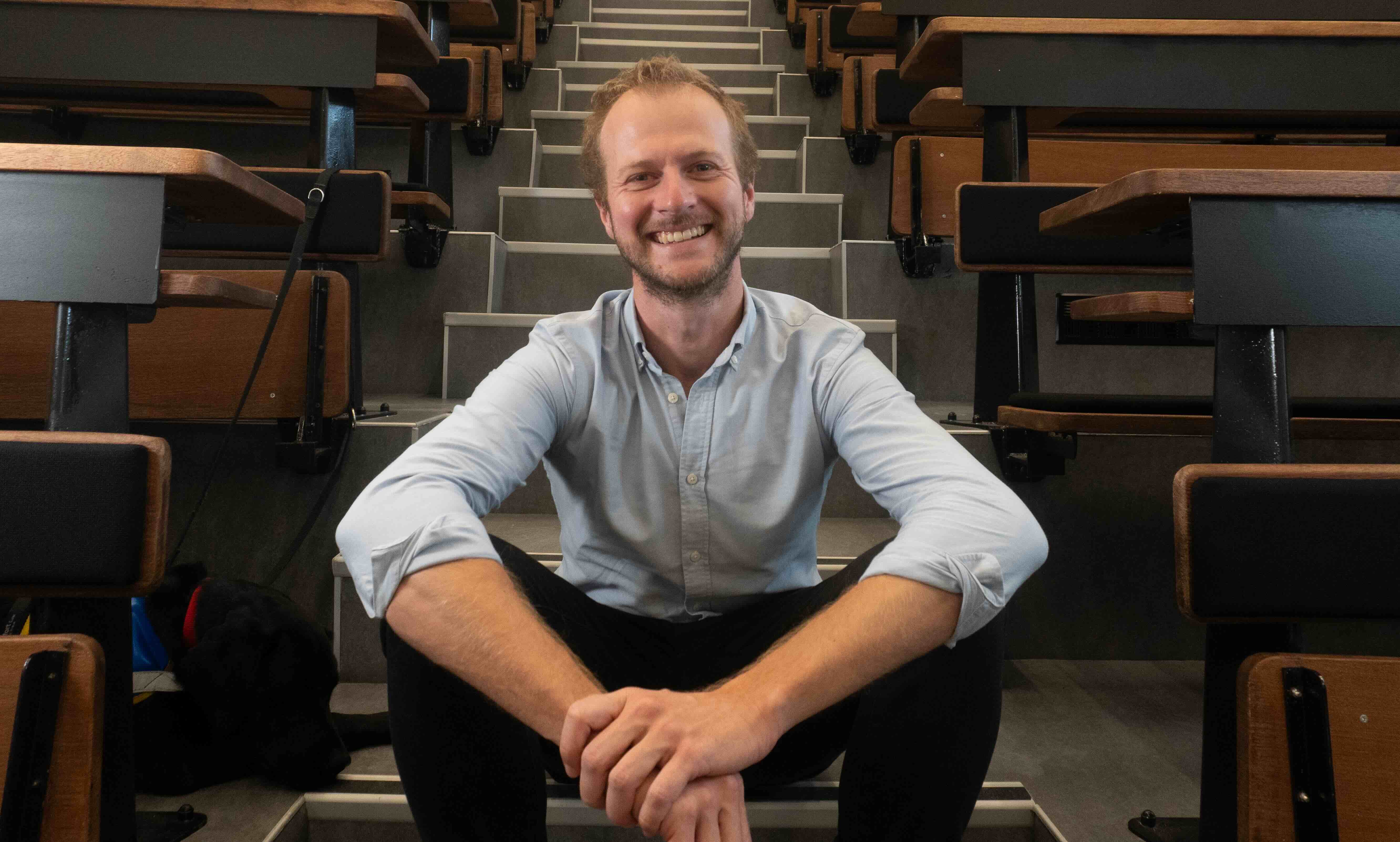
I am a research director at Inria, where I lead the Willow research group. Willow is a joint team of Inria, École normale supérieure, and CNRS, based in the Department of Computer Science at ENS in Paris.
My research focuses on physical AI, with the aim of giving robots the ability to reason about and act in the physical world. My approach brings together perception, optimization, machine learning, simulation, and control to help robots understand their surroundings, anticipate the consequences of their actions, and interact with their environment. I develop the mathematical foundations and computational tools that support these capabilities, with an emphasis on translating theoretical advances into practical algorithms and open-source software.
In September 2024, I was awarded an ERC Starting Grant for ARTIFACT, The ARTIficial Motion FACTory, which began in September 2025. If you are interested in contributing to this research, please see our open positions or get in touch.
Biography
My path into robotics began with a background in computer science and applied mathematics. I graduated with highest honors from École normale supérieure Paris-Saclay in 2013. In 2014, I worked with Katja Mombaur as a visiting student in the Optimization in Robotics and Biomechanics group at the University of Heidelberg, Germany.
From 2014 to 2017, I pursued my PhD in the Gepetto research group at LAAS-CNRS in Toulouse. My doctoral research examined the computational foundations of anthropomorphic locomotion: how we can understand human walking and translate that understanding into mathematical formulations for humanoid robot motion. This work established a thread that continues through my research today—using mathematics to understand movement and turn that understanding into algorithms.
After a postdoctoral appointment in Gepetto, I joined Willow as a postdoctoral researcher in September 2018. My research has since broadened from locomotion to the connections between perception, learning, simulation, and control, with physical interaction as a common focus.
One of my core motivations has always been to translate fundamental research into advanced, mature, and reliable software that anyone can use and build upon. This commitment has led me to create and lead the development of Pinocchio and several other open-source software projects.
Open positions
At Willow, we welcome talented postdoctoral researchers and engineers interested in tackling challenging problems in robotics. To express your interest, please complete our application form, and I will get back to you to discuss opportunities.
Research overview
In February 2023, I gave a talk to the IEEE RAS TC on Model-based Optimization for Robotics entitled Progress and Prospects in Optimisation for Learning and Control in Robotics. The talk offers an overview of our contributions to the field at that time.
Collaborators and team
I collaborate with Francis Bach, Adrien Taylor, Jean Ponce, Cordelia Schmid, Josef Sivic, and Ivan Laptev, alongside a team of talented and passionate researchers and engineers:
PhD students
- Roland Andrews, with Adrien Taylor.
- Franki Nguimatsia Tiofack.
- Théotime Le Hellard.
- Mathis Scheffler, with Cordelia Schmid.
- Loic Cabannes, with Hervé Jégou.
Postdoctoral researchers
- Fabian Schramm, reinforcement learning in robotics.
- Yann de Mont-Marin, differentiable simulation and geometric learning. Previously a PhD student (2020-2024) in Willow under the supervision of Jean Ponce and Jean-Paul Laumond.
- Etienne Ménager, differentiable simulation and optimal control for soft robots.
- Ajay Sathya, low-complexity algorithms for frugal and contact-rich simulation.
- Louis Montaut, differentiable simulation for contact-rich robotics; Coal expert.
Engineers
- Bruce Wingo.
- Joris Vaillant, expert in the Willow open-source software stack.
- Pierre-Guillaume Raverdy, manager of the Inria robotics facilities.
- Sarah El-Kazdadi, former PhD student, now a software engineer after returning from NVIDIA.
- Lucas Haubert, research engineer on optimization solvers for robotics and beyond.
Alumni
I have also had the pleasure of working with many passionate and inspiring postdoctoral researchers, PhD students, engineers, and visitors:
- Etienne Arlaud, former manager of the Inria robotics facilities. Now a software engineer at EGIDE.
- Frederike Dümbgen, global optimal control and estimation for robotics. Now an assistant professor at CMU.
- Ewen Dantec, whole-body and real-time model predictive control for rich contact interactions. Now a software engineer at Alten.
- Mégane Millan, Pinocchio software engineer. Now a research engineer at ISIR-UPMC.
- Olivier Roussel, Tirrex software engineer with Christian Duriez and Fabien Spindler.
- Etienne Moullet, postdoctoral researcher (2022-2025) with François Bailly and Christine Azevedo. Now a postdoctoral researcher at ISIR-UPMC.
- Wilson Jallet, non-smooth optimization for rich contact interactions; Aligator expert. Previously a PhD student (2021-2024), co-supervised with Nicolas Mansard. Now a research scientist at Capital Fund Management.
- Quentin Le-Lidec, postdoctoral researcher (2024-2025) on differentiable simulation for contact-rich robotics, and PhD student (2021-2024) co-supervised with Cordelia Schmid and Ivan Laptev. Now a postdoctoral researcher at AMI Labs with Yann LeCun. PhD thesis: Differentiable optimization for robotics: simulation, learning and control.
- Ludovic De Matteis, with Nicolas Mansard.
- Lander Vanroye, PhD visitor advised by Joris De Schutter and Wilm Decré.
- Oumayma Bounou, PhD student (2020-2024), co-supervised with Jean Ponce. Now a postdoctoral researcher at NYU with Yann LeCun. PhD thesis: Learning System Dynamics from Sensory Input under Optimal Control Principles.
- Antoine Bambade, PhD student (2020-2023), co-supervised with Adrien Taylor. Now a research scientist at EDF. PhD thesis: Primal-dual proximal augmented lagrangian methods for quadratic programming: theory and implementation.
- Sarah El-Kazdadi, former PhD student and software engineer. Now a linear algebra specialist at NVIDIA.
- Rohan Budhiraja, software engineer. Now at SquareMind.
- Armand Jordana, PhD student (2020-2024) co-supervised with Ludovic Righetti, and a master’s student in Willow in summer 2019. Now a postdoctoral researcher at LAAS-CNRS. PhD thesis: Reasoning About Perception Uncertainty in Nonlinear Model Predictive Control.
- Kateryna Zorina, advised by Josef Sivic and Vladimír Petrík.
My earlier robotics collaborations include work with Jean-Paul Laumond, Nicolas Mansard, Olivier Stasse, Mehdi Bennalegue, Andrea Del Prete and Steve Tonneau.
Software
I am the lead developer of several open-source robotics software projects. I believe open-source software helps advance both research and society by making cutting-edge methods broadly accessible.